
5. oktober 2026 – 12. oktober 2026 Sicily Folk High School
Walking and culture in Sicily
At our folk high school in Sicily, we have chosen to travel to south-eastern Sicily. On this autumn course, we have focused on an authentic experience in the countryside in one of Sicily's more beautiful regions, surrounded by olive groves and vines in the Ragusa region. The region is known for its beautiful baroque towns such as Ragusa, Ibla and Scicli, and for wonderful walking routes and authentic Sicilian cuisine.
On the course, we experience Sicilian food, culture and beautiful nature at close hand. We have morning exercise, morning singing, talks, and the folk high school atmosphere is present in everything we do.
We will be picking olives
We see how Sicilians live and work in the countryside, and we work alongside them when we pick olives in the folk high school's own olive grove. We also visit an olive press before enjoying a tasting of the folk high school's award-winning organic extra virgin olive oil.
Staying in two houses
On the course we stay in two houses: Villa Zottopera, an old, authentic and working olive farm, and an additional smaller house/hotel, Terre Iblee, since we cannot all stay in the main house. The latter is located about 4 km away and is a modern place with modern rooms (see photos of the two places under the heading "accommodation"). Both places have their own lovely pool. Despite the two properties, we are together as a group at the main house at Villa Zottopera both day and evening, with communal meals and various activities. We have a minibus that runs between the two houses when we have longer breaks in the programme. There are four transfers a day between the houses.
The walks (see a more detailed description in the programme)
Sicily's nature is beautiful, and on two of the days we go on day walks with packed lunches on some of the walking routes near the folk high school, one of the days on the Sicilian camino, the Cammino Ibleo.
The walks end respectively in Monterosso Almo, a charming village clinging to a cliff, and in Ragusa Ibla with its beautiful baroque buildings and cosy shops and cafés.
Italy's pantry
Sicily is called Italy's larder, and the island overflows with sun-ripened, fresh produce. The island has significant production of citrus fruits, cheeses and many kinds of nuts, vegetables, herbs and flours. We try our hand at some of them at a cookery school with the talented local chef Davide di Corato at his country house near the folk high school, where among other things we will make fresh pasta the Sicilian way.
Wine tasting
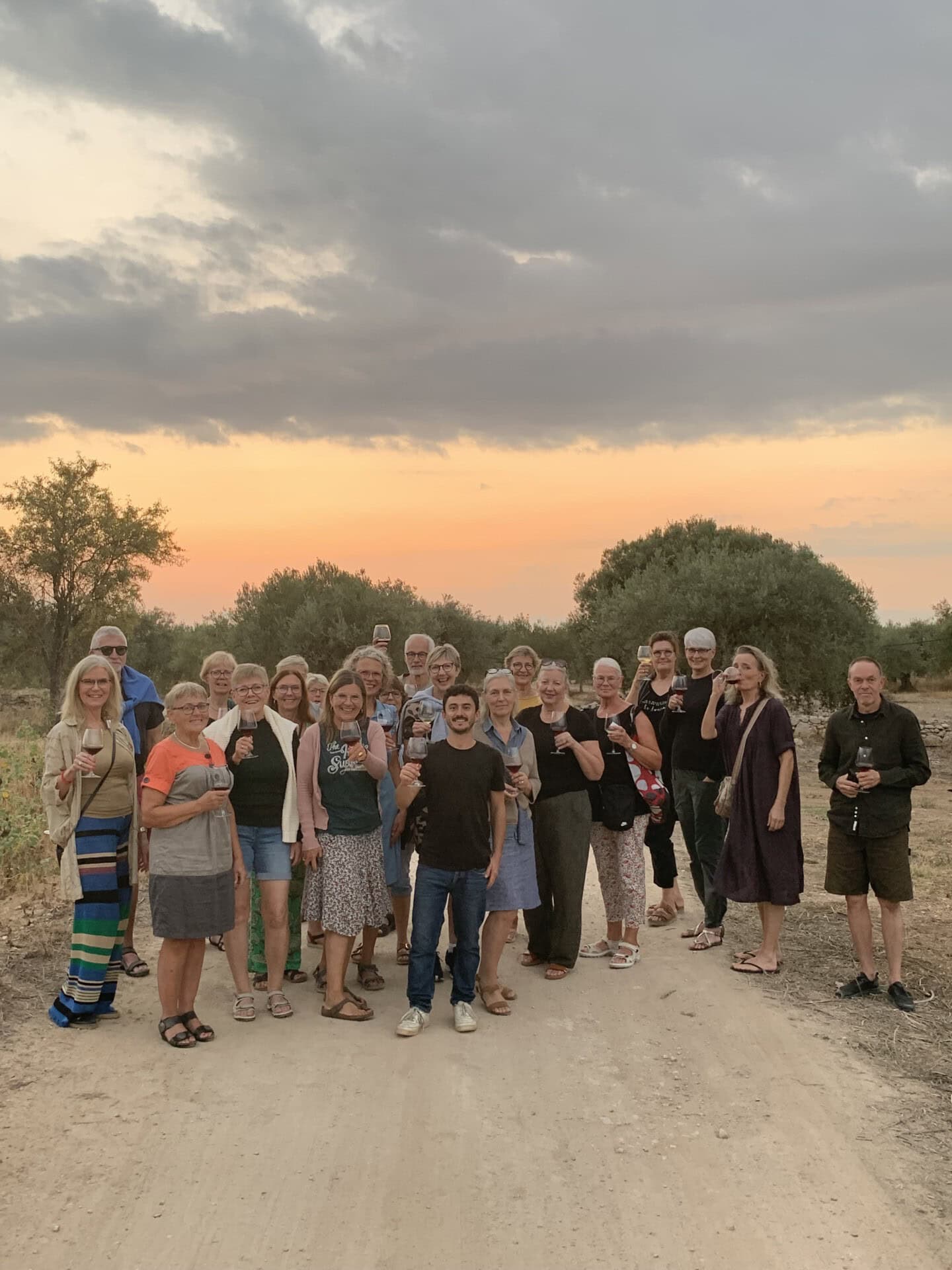
In addition to olives, the folk high school has a large number of vines, and of course we taste both the red and white wines they produce from old Sicilian grape varieties, and over the course of the week we are spoiled with delicious Sicilian food by our cook Anna, who lives at the folk high school.
We also take a trip to the Mediterranean and swim or walk along the beach in Sampieri before enjoying a festive Italian farewell dinner at our folk high school.
Payments
On booking, we ask for a deposit of kr. 3000. The balance must be paid 2 months before departure.
Alle kan være med
Du bestemmer selv dit tempo, og programmet tilpasses holdet. Er du i tvivl om noget, så ring til os — så tager vi den sammen.
Walking, culture and food in Sicily 5 October – 12 October 2026
Day 1: Monday 5.10: Travel to Sicily
9.40 Departure from Copenhagen Airport with Austrian Airlines. Flying via Vienna, arriving in Catania at 14.00.
Coach to the folk high school, approx. 1 hour and 15 minutes
Check-in at the two houses
19.30 Welcome and dinner
Day 2: Tuesday 6.10: Introduction to Sicily
8.15: Pick-up of the group at our second house, Terre Iblee
8.30: Morning exercise and singing by the pool with Bodil
9.00: Breakfast
10.00 - 11.30: The talk "Around Sicily" with Camilla
Break
12.00 - 13.00: Talk: "Sicily's multicultural cuisine" with Camilla
13.00: Lunch at the folk high school
Transfer to our second house and siesta in our two houses, which both have a garden and pool
17.00 We meet at the folk high school and take a walk together through the old buildings, the garden with citrus trees, pines, carob trees, vines and olive grove. Afterwards we settle down for the talk "Walking in Sicily" with Camilla.
19:00: Dinner at the folk high school
21.00: Transfer back to our second house
Day 3: Wednesday 7.10: Walk and visit to Ragusa Ibla
8.15 Pick-up of the group at our second house
8:30 Breakfast and pack a lunch
9:30 Departure for today's walk with our local walking guide Raffaella in the valley at the foot of Ragusa Ibla, one of the most charming towns in the Iblei Mountains. Streams run through the valley that once supplied Ragusa with water, and we see the remains of the old water mills where flour was ground for bread and pasta. We eat our packed lunches on the grass near the Benedictines' old Santa Maria della Misericordia monastery, before making our way up to the beautiful baroque town of Ragusa Ibla, which overlooks the mountains. There is always a pleasant atmosphere in front of the cathedral and on the corso, the pedestrian street with shops and cafés, and there is time on your own for an ice cream, shopping and relaxation in Ragusa Ibla before the coach picks us up
Approx. 16:30 -17.00 Departure by coach to our two houses and siesta
19:30 Dinner at the folk high school and a couple of evening songs
21.30: Transfer back to our second house
About today's walk: 12 km, approx. 4 - 4½ hours including breaks. During the day we have several ascents and descents on gravel, stone steps, forest floor and asphalt, which require concentration and good balance. We climb approximately 400 metres and descend 150 metres over the course of the day. At times the surface is uneven and stony, and it is an advantage to use walking poles today, as the walk is technically challenging, both on ascents and descents. Good walking shoes/boots with heel support and a solid sole are also preferable on this surface. There are two steep climbs at the end of the walk up to Ragusa Ibla. Difficulty: moderate
Day 4: Thursday 8.10: Sicilian cookery school
7.45: Pick-up of the group at our second house
8.00: Morning exercise and singing by the pool with Bodil
8.30: Breakfast
9.30: Today we focus on Sicilian cuisine and go to a cookery school at the idyllically located Poggio del Gallo farm, 6 km from the folk high school. We travel there by coach. At Poggio del Gallo, journalist, chef and cookbook author Davide di Corato is waiting to teach us how to make three different dishes with freshly made pasta and accompanying sauces. In Sicily, pasta is made in many different ways to suit the accompaniment, and other flours, ingredients and spices are used than elsewhere in Italy. During the day, Davide will also share his knowledge of food. Davide tells us his life story, which includes a great love of simple Sicilian food made from healthy fresh produce, and of wine. We eat our home-made Sicilian lunch, which includes wine, together with Davide and his wife Christina at Poggio del Gallo. Both Davide and Christiana speak English. After lunch there is a transfer in the afternoon at around 15.30 to our two houses, where there is a siesta
19.00: We meet again at the folk high school and hear a talk on Sicilian baroque architecture with Camilla
19.30: A light dinner at the folk high school and a couple of evening songs
21.30: Transfer back to our second house
Day 5: Friday 9.10: Culture and leisure in Scicli and relaxation by the Mediterranean
7.45: Pick-up of the group at our second house
8.00: Breakfast
9.00: Departure for Scicli. After a major earthquake in eastern Sicily in 1693, a large number of towns were razed to the ground and 90,000 people died. The towns were later rebuilt with beautiful palaces, churches and villas in the Sicilian baroque style, and Scicli is one of them. We take a walk through the compact town and look at the baroque façades with plump angels, theatrical figures, voluminous ornaments and grotesque faces that frighten passers-by with their bulging eyes and tongues hanging out of their mouths. Sicilian baroque is anything but dull. Afterwards there is time on your own in the charming town, with pedestrian streets and beautiful views if you make your way up the narrow lanes that climb the steep slopes surrounding the town.
Lunch is at your own expense. 14.30: We meet and drive the short way down to the coast and the beach at Sampieri, where you can swim or walk by the Mediterranean. In Sampieri the sandy beach is several kilometres long and a favourite of the locals. There are basic changing facilities and a café on the beach
16.00: The coach takes us home to the two houses, where we have a little siesta before dinner
19.00: We meet again at the folk high school and hear a talk about olives and get information about tomorrow's olive harvest with Camilla
19.30: Dinner at the folk high school and an evening song or two
21.30: Transfer back to our second house
Day 6: Saturday 10.10: Olive picking, visit to an olive press, olive and wine tasting
8.15: Pick-up of the group at our second house
8.30: Morning exercise and singing by the pool with Bodil
9:00: Breakfast
10.00: October is entirely dedicated to the olive in Sicily. The branches of the trees burst with life, laden with ripe green olives, and every olive producer on the island is busy bringing in the harvest and pressing the fruit into the thousands of litres of olive oil the Sicilians produce each year. We take part in that work when we pick olives in the folk high school's olive grove today. After breakfast we roll up our sleeves and follow Alfredo or Giuseppe out into the olive grove, where we are introduced to olive picking. Which tools we will use and the picking technique itself are explained. We then pick for a couple of hours and gather the day's harvest into crates, which shortly after picking are taken to an olive press and pressed. The folk high school's olives are much sought after, as they are of the rare Tonda Iblea variety, of which few remain. Tonda Iblea olives yield only 10% oil per picked fruit, whereas other varieties give up to 40%. In return, the quality is very high, and because it is also hand-picked and organic, the folk high school exports it as far as Japan, the USA and around Europe to restaurants that value high quality.
12.00: We enjoy a tasting of the folk high school's award-winning olive oils with Giuseppe in the folk high school's barn around the large old stone press, where earlier generations of the Rosso family pressed olives. There is an opportunity to buy olive oil to take home.
13.00: Lunch with a tasting of the folk high school's own red and white wines, with Marcello at the folk high school. Transfer to the second house and siesta in the two houses
16.30: We meet at the folk high school and walk 2 km along the road to the nearby olive press Oleificio Guccione, where we meet the owner, who will tell us about his business and his work with olives, in English. Here we witness how freshly picked olives are immediately turned into extra virgin olive oil, and see the whole process from A to Z, from the olives being washed to being centrifuged and finally ending up as fragrant oil. Afterwards we walk back to the folk high school, where there is a short break before dinner
19.00: Dinner at the folk high school and information about tomorrow's walk
20.00: Song evening with songs from the Folk High School Songbook with Bodil
21.30: Transfer to our second house
Transport: Walk 2 km there and back to the olive press along a flat country road
Day 7: Sunday 11.10: Walk on the Cammino Ibleo, the Sicilian camino
8.00: Pick-up of the group at our additional house
8:15: Breakfast and pack a lunch
9.15: Departure by coach to the walking route. We start by driving half an hour up to Chiaramonte Gulfi, Sicily's highest town at almost 800 m above sea level, from where we begin today's walk with Raffaella. Our destination is the village of Monterosso Almo. The stretch is part of the Sicilian camino, the Cammino Ibleo, which winds through south-eastern Sicily. We start on a hilly limestone plateau and continue up and down gravel paths. Along the way we pass farms and rural landscape and eat our packed lunches. As we approach Monterosso Almo, we see how the village is beautifully situated on a cliff overlooking the Iblei Mountains. Monterosso Almo is classified as one of "I Borghi più belli d'Italia", a collection of Italy's most beautiful historic villages, and has 3,000 inhabitants. We walk up to Monterosso Almo, a steep and long climb, and finish in the town's central square, Piazza San Giovanni, where there is a chance to enjoy a refreshment after the walk
Approx. 16.00 Departure by coach back to our two houses, where there is a siesta
19.00: Farewell dinner at the folk high school – we finish with a couple of evening songs
21.30: Transfer to our second house
About today's walk: 13 – 14 km, ascent 250 m, approx. 5 – 5½ hours including breaks. We walk on gravel paths, forest floor and asphalt. At times the surface is quite uneven and stony and requires good concentration, and it is an advantage to use walking poles today, as the walk is technically challenging, both on ascents and descents. Good walking shoes/boots with heel support and a solid sole are also preferable on this surface. At the end of the walk there is a longer climb up to Monterosso Almo. Difficulty: moderate
Day 8: Monday 12.10: Visit to Syracuse and return journey
7.30: Pick-up of the group at our second house
7:45: Breakfast and farewell
9.00: We drive 1½ hours to Syracuse's old town, which lies on the island of Ortigia, measuring just one kilometre at its longest and 500 metres at its widest. Syracuse is a must when you visit Sicily, for the town's winding streets and beautiful buildings and squares tell the whole thousand-year cultural history of Sicily. In Syracuse we first walk together to the town's market and may continue in the footsteps of Plato and Archimedes, sensing that the island was an ancient Greek colony. We see the remains of the Temple of Apollo and continue along the town's winding streets up to the cathedral. Here we see the famous baroque cathedral, a converted Greek temple, which lies in the middle of the island's central square, Piazza Duomo. The square is one of Sicily's most beautiful, surrounded by baroque palaces, and is always atmospheric with cafés serving classic Sicilian specialities such as granita: a sorbet ice made from everything from almonds, coffee, pistachios and citrus fruit, served with a buttery brioche. Syracuse is a great place to shop and soak up the last rays of sun. We part at the cathedral and then have a little time on our own to eat lunch and shop
approx. 15.30: Departure to the airport in Catania
18.35 Flight to Copenhagen via Munich, arriving at Copenhagen Airport at 23.30
Subject to change.
Programme
Walking, culture and food in Sicily 5 October – 12 October 2026
Day 1: Monday 5.10: Travel to Sicily
9.40 Departure from Copenhagen Airport with Austrian Airlines. Flying via Vienna, arriving in Catania at 14.00.
Coach to the folk high school, approx. 1 hour and 15 minutes
Check-in at the two houses
19.30 Welcome and dinner
Day 2: Tuesday 6.10: Introduction to Sicily
8.15: Pick-up of the group at our second house, Terre Iblee
8.30: Morning exercise and singing by the pool with Bodil
9.00: Breakfast
10.00 - 11.30: The talk "Around Sicily" with Camilla
Break
12.00 - 13.00: Talk: "Sicily's multicultural cuisine" with Camilla
13.00: Lunch at the folk high school
Transfer to our second house and siesta in our two houses, which both have a garden and pool
17.00 We meet at the folk high school and take a walk together through the old buildings, the garden with citrus trees, pines, carob trees, vines and olive grove. Afterwards we settle down for the talk "Walking in Sicily" with Camilla.
19:00: Dinner at the folk high school
21.00: Transfer back to our second house
Day 3: Wednesday 7.10: Walk and visit to Ragusa Ibla
8.15 Pick-up of the group at our second house
8:30 Breakfast and pack a lunch
9:30 Departure for today's walk with our local walking guide Raffaella in the valley at the foot of Ragusa Ibla, one of the most charming towns in the Iblei Mountains. Streams run through the valley that once supplied Ragusa with water, and we see the remains of the old water mills where flour was ground for bread and pasta. We eat our packed lunches on the grass near the Benedictines' old Santa Maria della Misericordia monastery, before making our way up to the beautiful baroque town of Ragusa Ibla, which overlooks the mountains. There is always a pleasant atmosphere in front of the cathedral and on the corso, the pedestrian street with shops and cafés, and there is time on your own for an ice cream, shopping and relaxation in Ragusa Ibla before the coach picks us up
Approx. 16:30 -17.00 Departure by coach to our two houses and siesta
19:30 Dinner at the folk high school and a couple of evening songs
21.30: Transfer back to our second house
About today's walk: 12 km, approx. 4 - 4½ hours including breaks. During the day we have several ascents and descents on gravel, stone steps, forest floor and asphalt, which require concentration and good balance. We climb approximately 400 metres and descend 150 metres over the course of the day. At times the surface is uneven and stony, and it is an advantage to use walking poles today, as the walk is technically challenging, both on ascents and descents. Good walking shoes/boots with heel support and a solid sole are also preferable on this surface. There are two steep climbs at the end of the walk up to Ragusa Ibla. Difficulty: moderate
Day 4: Thursday 8.10: Sicilian cookery school
7.45: Pick-up of the group at our second house
8.00: Morning exercise and singing by the pool with Bodil
8.30: Breakfast
9.30: Today we focus on Sicilian cuisine and go to a cookery school at the idyllically located Poggio del Gallo farm, 6 km from the folk high school. We travel there by coach. At Poggio del Gallo, journalist, chef and cookbook author Davide di Corato is waiting to teach us how to make three different dishes with freshly made pasta and accompanying sauces. In Sicily, pasta is made in many different ways to suit the accompaniment, and other flours, ingredients and spices are used than elsewhere in Italy. During the day, Davide will also share his knowledge of food. Davide tells us his life story, which includes a great love of simple Sicilian food made from healthy fresh produce, and of wine. We eat our home-made Sicilian lunch, which includes wine, together with Davide and his wife Christina at Poggio del Gallo. Both Davide and Christiana speak English. After lunch there is a transfer in the afternoon at around 15.30 to our two houses, where there is a siesta
19.00: We meet again at the folk high school and hear a talk on Sicilian baroque architecture with Camilla
19.30: A light dinner at the folk high school and a couple of evening songs
21.30: Transfer back to our second house
Day 5: Friday 9.10: Culture and leisure in Scicli and relaxation by the Mediterranean
7.45: Pick-up of the group at our second house
8.00: Breakfast
9.00: Departure for Scicli. After a major earthquake in eastern Sicily in 1693, a large number of towns were razed to the ground and 90,000 people died. The towns were later rebuilt with beautiful palaces, churches and villas in the Sicilian baroque style, and Scicli is one of them. We take a walk through the compact town and look at the baroque façades with plump angels, theatrical figures, voluminous ornaments and grotesque faces that frighten passers-by with their bulging eyes and tongues hanging out of their mouths. Sicilian baroque is anything but dull. Afterwards there is time on your own in the charming town, with pedestrian streets and beautiful views if you make your way up the narrow lanes that climb the steep slopes surrounding the town.
Lunch is at your own expense. 14.30: We meet and drive the short way down to the coast and the beach at Sampieri, where you can swim or walk by the Mediterranean. In Sampieri the sandy beach is several kilometres long and a favourite of the locals. There are basic changing facilities and a café on the beach
16.00: The coach takes us home to the two houses, where we have a little siesta before dinner
19.00: We meet again at the folk high school and hear a talk about olives and get information about tomorrow's olive harvest with Camilla
19.30: Dinner at the folk high school and an evening song or two
21.30: Transfer back to our second house
Day 6: Saturday 10.10: Olive picking, visit to an olive press, olive and wine tasting
8.15: Pick-up of the group at our second house
8.30: Morning exercise and singing by the pool with Bodil
9:00: Breakfast
10.00: October is entirely dedicated to the olive in Sicily. The branches of the trees burst with life, laden with ripe green olives, and every olive producer on the island is busy bringing in the harvest and pressing the fruit into the thousands of litres of olive oil the Sicilians produce each year. We take part in that work when we pick olives in the folk high school's olive grove today. After breakfast we roll up our sleeves and follow Alfredo or Giuseppe out into the olive grove, where we are introduced to olive picking. Which tools we will use and the picking technique itself are explained. We then pick for a couple of hours and gather the day's harvest into crates, which shortly after picking are taken to an olive press and pressed. The folk high school's olives are much sought after, as they are of the rare Tonda Iblea variety, of which few remain. Tonda Iblea olives yield only 10% oil per picked fruit, whereas other varieties give up to 40%. In return, the quality is very high, and because it is also hand-picked and organic, the folk high school exports it as far as Japan, the USA and around Europe to restaurants that value high quality.
12.00: We enjoy a tasting of the folk high school's award-winning olive oils with Giuseppe in the folk high school's barn around the large old stone press, where earlier generations of the Rosso family pressed olives. There is an opportunity to buy olive oil to take home.
13.00: Lunch with a tasting of the folk high school's own red and white wines, with Marcello at the folk high school. Transfer to the second house and siesta in the two houses
16.30: We meet at the folk high school and walk 2 km along the road to the nearby olive press Oleificio Guccione, where we meet the owner, who will tell us about his business and his work with olives, in English. Here we witness how freshly picked olives are immediately turned into extra virgin olive oil, and see the whole process from A to Z, from the olives being washed to being centrifuged and finally ending up as fragrant oil. Afterwards we walk back to the folk high school, where there is a short break before dinner
19.00: Dinner at the folk high school and information about tomorrow's walk
20.00: Song evening with songs from the Folk High School Songbook with Bodil
21.30: Transfer to our second house
Transport: Walk 2 km there and back to the olive press along a flat country road
Day 7: Sunday 11.10: Walk on the Cammino Ibleo, the Sicilian camino
8.00: Pick-up of the group at our additional house
8:15: Breakfast and pack a lunch
9.15: Departure by coach to the walking route. We start by driving half an hour up to Chiaramonte Gulfi, Sicily's highest town at almost 800 m above sea level, from where we begin today's walk with Raffaella. Our destination is the village of Monterosso Almo. The stretch is part of the Sicilian camino, the Cammino Ibleo, which winds through south-eastern Sicily. We start on a hilly limestone plateau and continue up and down gravel paths. Along the way we pass farms and rural landscape and eat our packed lunches. As we approach Monterosso Almo, we see how the village is beautifully situated on a cliff overlooking the Iblei Mountains. Monterosso Almo is classified as one of "I Borghi più belli d'Italia", a collection of Italy's most beautiful historic villages, and has 3,000 inhabitants. We walk up to Monterosso Almo, a steep and long climb, and finish in the town's central square, Piazza San Giovanni, where there is a chance to enjoy a refreshment after the walk
Approx. 16.00 Departure by coach back to our two houses, where there is a siesta
19.00: Farewell dinner at the folk high school – we finish with a couple of evening songs
21.30: Transfer to our second house
About today's walk: 13 – 14 km, ascent 250 m, approx. 5 – 5½ hours including breaks. We walk on gravel paths, forest floor and asphalt. At times the surface is quite uneven and stony and requires good concentration, and it is an advantage to use walking poles today, as the walk is technically challenging, both on ascents and descents. Good walking shoes/boots with heel support and a solid sole are also preferable on this surface. At the end of the walk there is a longer climb up to Monterosso Almo. Difficulty: moderate
Day 8: Monday 12.10: Visit to Syracuse and return journey
7.30: Pick-up of the group at our second house
7:45: Breakfast and farewell
9.00: We drive 1½ hours to Syracuse's old town, which lies on the island of Ortigia, measuring just one kilometre at its longest and 500 metres at its widest. Syracuse is a must when you visit Sicily, for the town's winding streets and beautiful buildings and squares tell the whole thousand-year cultural history of Sicily. In Syracuse we first walk together to the town's market and may continue in the footsteps of Plato and Archimedes, sensing that the island was an ancient Greek colony. We see the remains of the Temple of Apollo and continue along the town's winding streets up to the cathedral. Here we see the famous baroque cathedral, a converted Greek temple, which lies in the middle of the island's central square, Piazza Duomo. The square is one of Sicily's most beautiful, surrounded by baroque palaces, and is always atmospheric with cafés serving classic Sicilian specialities such as granita: a sorbet ice made from everything from almonds, coffee, pistachios and citrus fruit, served with a buttery brioche. Syracuse is a great place to shop and soak up the last rays of sun. We part at the cathedral and then have a little time on our own to eat lunch and shop
approx. 15.30: Departure to the airport in Catania
18.35 Flight to Copenhagen via Munich, arriving at Copenhagen Airport at 23.30
Subject to change.
Meet your instructors
Camilla Kornerup:
Our course leader is Camilla Kornerup, who is a speaker and tour leader and runs the lecture business Cosmopolit, where among other things she gives talks about Sicily. Camilla previously worked as a tour guide in Italy and has since travelled in the country countless times. Camilla has extensive knowledge of Italian and Sicilian culture and will give several talks and lead some of the tours during the week. Camilla has a background as a Master of Arts in Spanish and religion and worked as a teacher and independent consultant for a number of years before settling in Scotland in 2020, where she also leads our folk high school courses in Scotland
Bodil Pugholm
Our course assistant is Bodil Pugholm. Bodil holds a Master of Arts in psychology and communication and works for an NGO when she is not away with Annas Højskole. She is also a trained nature therapist. Bodil lived for a year in Rome during her studies and worked as a tour guide in Sardinia, so she speaks Italian and greatly enjoys talking with Italians about their lives and everyday life. Italy therefore holds a special place in her heart. Since childhood, Bodil has sung and played the piano, and for 14 years she has sung in the Copenhagen a cappella choir, Vokalkompagniet. And she has a fondness for the Folk High School Songbook, which she loves to bring out on any given occasion. On the course she will be in charge of the morning singing and the morning exercise. Privately, Bodil lives with her husband Jacob and their two boys aged 2 and 4.
Alfredo Rosso
Alfredo runs Villa Zottopera together with his brother Giuseppe, and makes things happen and ends meet.
Anna
Anna is our cook. Anna has been a chef at Villa Zottopera for 20 years, where she also lives with her husband Antonello, who is a gardener and helps out in the kitchen. Anna's specialities are focaccia with herbs and home-made pasta dishes. Anna uses exclusively local products from the area and has a large kitchen garden with peppers, courgettes, aubergines and more. Anna was born and raised in Ragusa, where the best Sicilian cheeses from cows and sheep come from: ricotta, caciocavallo, ragusano, primo sale and pecorino siciliano, and she loves to use them in her cooking.
Guiseppe Rosso
Giuseppe runs Villa Zottopera together with his brother Alfredo, and is also responsible for the olive production. Giuseppe has been a pioneer in setting up the consortium that classifies the olive oil in the Ragusa area, and is proud that Villa Zottopera's organic extra virgin olive oil is still hand-picked and has customers all over the world, including the Louis Vuitton group and various gourmet restaurants. Zottopera olive oil has won countless international awards, and Giuseppe tells us why during our olive tasting with him, which takes place in the farm's original and atmospheric trappeto, where the olive press used in the old days still stands together with the stone vats and tools they used in times gone by. Giuseppe speaks English.
Marcello Rosso
Marcello is the youngest branch on the Rosso family tree, and Giuseppe's son. Marcello is in charge of the farm's wine production and develops both red and white wines, carrying on the family's centuries-old traditions at Antiche Cantine Rosso. The red grapes include Frappato, Nero d'Avola and Syrah, the whites Grillo and Fiano. Marcello has manually pruned all of the farm's vines using the latest techniques, makes exclusively organic wine, and is committed to sustainability and biodiversity. Marcello speaks English.
Davide di Corato
Davide di Corato is a journalist specialising in food, and a self-taught chef, and has worked as a food and wine critic and as an editor of food magazines. Davide has devoted himself to cooking in recent years and is frequently used as a guest chef at a number of renowned restaurants in Italy. Alongside this, Davide writes books about Italian food and has published cookbooks on cheese, wine and Italian sausages, among other things. He is currently putting the finishing touches to his tenth book. Since 2005, Davide and his wife Christina have run the country estate Poggio del Gallo at the foot of Chiaramonte Gulfi, 6 km from the folk high school. The couple have thoroughly renovated an old farm, where they have agriculture and a kitchen garden and rent out two rooms to food-loving tourists. At Poggio del Gallo, Davide has a cookery school where he teaches Sicilian cooking and shares his enormous knowledge of everything from the Sicilian table. Davide speaks English.
Raffaella Spadola
Raffaella is our English-speaking local guide on the two walks in the Iblei Mountains, and Raffaella will tell us all about the landscape and the nature we encounter along the way. Raffaella has lived and walked in Sicily for almost 20 years and lives in the small, charming harbour town of Marina di Ragusa.
Praktisk & pris
Outbound: 5.10.2026
9.40 Departure from Copenhagen Airport with Austrian Airlines
11.20 Arrival in Vienna
12.00 Departure from Vienna
14.00 Arrival in Catania
Return journey: 12.10.2026
18.35 Departure from Catania with Lufthansa
20.45 Arrival in Munich
21.55 Departure from Munich
23.30 Arrival at Copenhagen Airport
*Subject to change
Price includes
- Accommodation in rooms with private or shared bathroom depending on what you have booked
- Access to a lovely authentic farm as the setting for our folk high school
- Return flight
- Danish course leader
- Danish assistant
- All meals at the folk high school including water – other drinks can be purchased separately
- Coffee + tea at the folk high school
- Tuition at the cookery school
- Packed lunch on the walks
- All talks
- All coach transfers
- Local guide on the walks
- Olive picking
- Olive tasting
- Wine tasting
- Contribution to the Danish Travel Guarantee Fund
- Flight taxes and environmental charges
- Tourist taxes
Price excludes
- 2* lunch
- Drinks with all meals
- Tips for the folk high school staff (we collect a little euro on the last evening)
- Payment:
- On booking, we ask for a deposit of kr. 3000. The balance must be transferred 2 months before departure.
- In special cases it is possible to pay by Mastercard; please write this on the booking form if desired.
Billeder
What our guests say
“Tak for en fantastisk oplevelse, ikke mindst takket være Anna og dig. Du var en inspirerende rejseleder, der gjorde turen til meget mere end bare en pilgrimsvandring.”
“Skøn tur som puttes i rygsækken med fantastiske oplevelser, smukke fotos og den bedste kursusleder Michael Birkkjær Lauritsen. Elsker oplevelser med Annas Højskole.”
“Jeg har netop været på strikkehøjskole på Læsø ved Annette Danielsen. Uanset hvor hårdt jeg anstrenger mig, kan jeg simpelthen ikke finde noget negativt at sige. Annette Danielsen er en fuldstændig fantastisk inspirerende og forrygende formidler. Østergaard B&B er et skønt sted med lækre lejligheder, dejlig og velsmagende mad, og en meget sympatisk og underholdende vært. Vi mødte skønne og inspirerende fortællere i huset og på ture på Læsø. Vi startede dagene med morgensang sammen med Jens Christian, som fint fortalte lidt om de sange, vi sang. Dejlig start på nogle vidunderlige dage. Det har bare været helt igennem en skøn, pragtfuld og fantastisk uge. Føler mig meget beriget.”
Ofte stillede spørgsmål
Kan jeg rejse med, hvis jeg rejser alene?
Ja — rigtig mange af vores kursister rejser alene. Du bliver en del af fællesskabet fra første dag, og du kan vælge eget værelse, hvis du vil have ro omkring dig.
Hvor god en form skal jeg være i?
Alle kan være med! Programmet tilpasses holdet, og du bestemmer selv dit tempo. Er du i tvivl, så ring til os — så tager vi den sammen.
Hvordan foregår betalingen?
Du reserverer din plads med et depositum og modtager en faktura pr. e-mail. Restbeløbet betales senest 60 dage før afrejse — også via faktura og bankoverførsel.
Hvad hvis jeg bliver nødt til at aflyse?
Vores afbestillingsregler står i rejsereglerne for pakkerejser, og vi er medlem af Rejsegarantifonden (reg.nr. 3122). Kontakt os hurtigst muligt, hvis noget kommer i vejen — vi finder altid en løsning sammen.
Kan I tage hensyn til allergier og særlige behov?
Ja. Når du reserverer, spørger vi ind til kost, allergier og særlige behov, og vi giver besked videre til køkkenet og værterne på destinationen.
Er der dansktalende værter med på rejsen?
Ja, altid. Der er dansktalende kursusledere og værter med på alle vores ophold.
Reserve your place
1. Choose room · 2. Your details · 3. Confirm