
26. april 2027 – 3. maj 2027 Galicia Folk High School
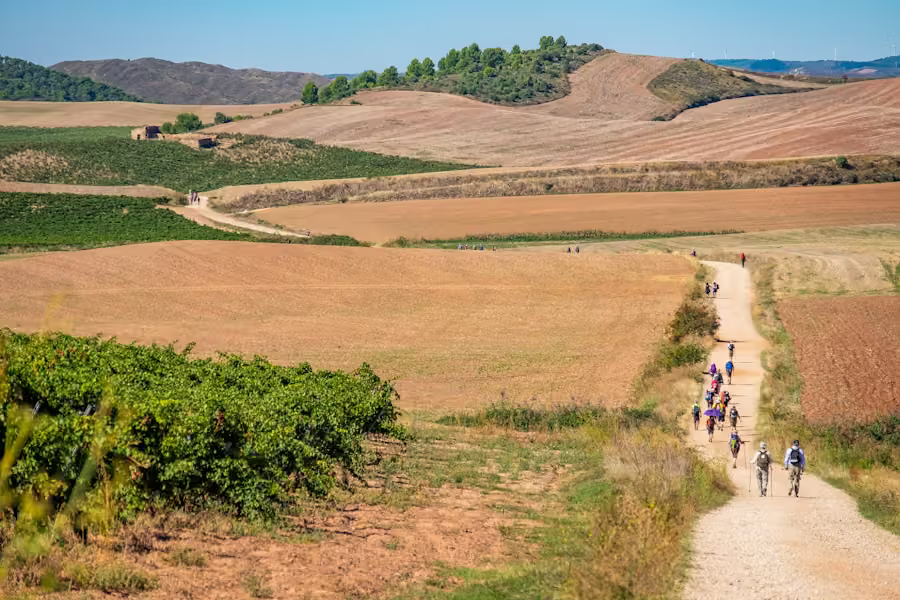
Folk high school walking on the historic Camino in Spain
Experience the beautiful conclusion of The French Way; El Camino Francés: one of the original and most famous routes on El Camino de Santiago, with many legendary stops along the way.
We are so fortunate that our course leader is a bit of a scoop; he is local, but also Danish, namely Michael Birkkjær Lauritsen, who lives with his Spanish-Danish family in Galicia. Also joining this first pilgrim walk in Galicia is the principal of Annas Højskole, Anna Katrin Nørgaard.
On the trip we prioritise room for:
- Knowledge and background
- Silence and reflection
- Nature and local food
We walk just over 100 kilometres, so that after completing the walk you can receive a Camino certification at the pilgrim office in Santiago de Compostela. The level of difficulty is moderate, so many people can take part.
The French Way
We start in the town of Sarria, 110 kilometres on foot east of Santiago de Compostela, just west of the mountain range Serra dos Ancares. In Portomarin we cross the important river Miño, which forms part of the border with Portugal and is symbolised by the blue stripe in the flag of Galicia. We cross historic villages, see Romanesque churches, monasteries, bridges and stone crosses (cruceiros), as well as the famous horreos for storing crops in the humid Galicia. We walk alongside beautiful nature and cultivated fields before we arrive in Santiago de Compostela with its impressive medieval centre and the beautiful cathedral, which for more than a thousand years has attracted pilgrims from all over Europe - and the world. Here we attend the pilgrim mass in the cathedral, get our Camino certification and take a town walk together with Michael.
Why this trip?
We arrange this trip because walking is good for the body and for the mind. Walking creates a space where thoughts can fall into place at their own pace. In addition, Michael would very much like to show off his beautiful Galicia and tell us about the region.
Morning song and 'the pilgrim word of the day'
Every morning, once we are out on the route, we sing a morning song and get an introduction to the pilgrim word of the day. These are words such as responsibility, community and independence, slowness, freedom and freedom from worry. As we walk, there is plenty of time to think further on your own, but also perhaps to talk together: How do you understand the concept? What does it mean in my life today? Should it perhaps be given more room in the future?
Silent walking
Along the way we also walk about 60 minutes in silence each day - but to the sound of nature's sounds and the rhythm of shared footsteps. This gives an opportunity to take in nature and let your thoughts fall into place. Later in the afternoon we reach the day's overnight stop. Here there is time to take a bath, stretch your legs or go out for a drink. Every day we stay at good hotels with a private toilet and bath. In the evening we meet for a shared dinner, where we have tasty local dishes & wine and enjoy ourselves after a good, long day's walking.
Information about Galicia and Spain
During dinner there will be time to follow up on the day's theme, and Michael finds some good moments to go into, in small afternoon or evening talks:
The history of the Camino:
How Spain became Spain, and how Europe became the Europe we know today, and how the Camino played a completely central role in both. We hear about how the Camino was used by small Christian kingdoms in northern Spain, by the Pope and by great European powers to the north, to prop up their own power and support the conquest of the Iberian Peninsula from the Muslims who took most of the peninsula in 711.
The significance of the mussel:
Not only as a symbol of the Camino, but also as a sustainable, protein-rich and delicious food that thrives in the very special currents off Galicia's Atlantic coasts, which is why Galicia is famous in Spain for its seafood in general: for, among other things, blue mussels, oysters, scallops, cockles, razor clams, crabs, prawns and octopus.
The significance of food in Spain:
Why do the Spanish spend twice as much time as Danes preparing and eating food? We will hear about the schoolchildren who eat three courses at school, and about how many a Sunday is spent eating with family and friends, and how it is quite acceptable for it to take a long time. We know very well that it is healthy, but how does it fit together with the rest of everyday life, when you have to spend so much time eating?
The nature around us:
in Galicia we walk through incredibly beautiful landscapes, and together we focus on which animals, birds and flora we know from Denmark, and Michael also tells us about the more exotic elements, including the eucalyptus tree, which was introduced massively into forestry under Franco.
The Sarria-Santiago route in detail
Sarria – Portomarín: 22 km
Portomarín – Palas de Rei: 25.1 km
Palas de Rei – Melide: 14.6 km
Melide – Arzúa: 14.5 km
Arzúa – Lavacolla: 29 km
Lavacolla – Santiago de Compostela: 10 km
Your luggage is transported for you
We walk 10-29 km daily and have the luggage transported, so you carry only a day pack with whatever you might want with you, e.g. water, fruit, nuts and an extra jumper. We take our time over the day's stretch, and only on one day do we have a larger ascent, so everyone in normal good shape can join in. We each buy lunch ourselves at a café along the day's route. (The first lunch is included in the price.)
Welcome to a beautiful week through Galicia. Rich in nature, reflection, learning and folk high school life.
Payments
On registration we ask for a deposit of kr. 3000,-. The balance must be paid 2 months before departure.
Alle kan være med
Du bestemmer selv dit tempo, og programmet tilpasses holdet. Er du i tvivl om noget, så ring til os — så tager vi den sammen.
Folk high school walking on the historic Camino in Spain 26 April - 3 May 2027
26.4. Day 1: Denmark - Galicia
Departure from Copenhagen Airport with a direct flight to Porto, and a bus from there to our starting town of Sarria, where we check in at Hotel Novoa. Our course leader Michael Birkkjær Lauritsen and Anna introduce themselves and tell us about the framework and the ideas for the week we have ahead of us.
Sarria is today one of the larger villages on the Galician part of The French Way on the Camino.
27.4. Day 2: Sarria – Portomarín: 22 km
8.00 Shared breakfast. We do a “who's who” round? What made you sign up for a Camino walk with Annas Højskole? We go over the day's route, and Michael tells us about the legend and the cult surrounding St James (St Ib) and the origin of the Camino.
After departure we find a spot in nature where we sing a morning song or two and get an introduction to the word of the day.
The start of our route after breakfast is beautiful. We walk past the Church of the Saviour, the town wall's former defence tower and the Madalena monastery. After barely two kilometres we enter one of the harder stretches of the walk, as we are still at the end of the mountains that “for better or worse” separate Galicia from the rest of Spain. It is a stretch of a good four kilometres, which starts after a descent on a path of hewn stones, over a bridge, along a railway track, after which we have a big ascent. We walk at between 600 and 700 metres of altitude. After the little village of Ferreiros there are a couple of eating places we can spread out across, so that we can continue together after lunch. You are also welcome to walk at your own pace and find lunch on your own; there are several places along the way.
Around the 15th kilometre the descent to Portomarín begins, and it is also in this area that we come across the famous 100 km stone.
Every day we pass a number of stone churches, stone houses, stone crosses and the typical horreos (small silos for maize, grain, potatoes and vegetables, which are raised off the ground and have historically had the dual function of protecting against damp and pests).
We finish in Portomarín by the river Miño, which further south forms the border with Portugal and appears as the blue stripe in the Galician flag. Portomarín is a fine village with cobblestones and the lovely San Xoan church.
In Portomarín we check in at Hotel Vistalegre.
19.00 Shared dinner at Restaurant Pérez right next to the hotel. During dinner we talk about the day that has passed and reflect on the word of the day.
28.4. Day 3: Portomarin – Palas de Rei: 25.1 km
8.00 Shared breakfast, where we go over the day's route, and Michael tells us about the Galician nature, geography and cultural landscapes, including the many hills, the wild coasts and the rich wildlife - and also about the not entirely uncontroversial forestry, based on eucalyptus trees, and the extensive agriculture that reveals itself to us on the route and, among other things, makes Galicia Spain's largest milk producer.
After departure we find a spot in nature where we sing a morning song or two and get an introduction to the word of the day.
The day's route begins with hills, the first roughly 10 kilometres. We take care to bring everyone along.
We take a break after 7.5 kilometres if necessary, and otherwise we continue to the fascinating pre-Roman (Celtic) hillfort at about 10 kilometres. Here we take a break, and Michael tells us briefly about castros and the pre-Roman Celts, who are an important part of the Galician cultural heritage.
For those who want to, we have lunch together somewhere on the route, perhaps in the town of O Hospital after barely 12 kilometres, or in Ventas de Naron, just after, at 13 kilometres. As mentioned, you are also welcome here to walk on your own and eat at your own pace.
From about 15 kilometres the descent begins. We are then at 720 metres of altitude, and from now on it goes more downhill than uphill for the rest of the route to Santiago. We will of course still meet ascents, but it generally goes more downhill.
After 25 kilometres we arrive at a lovely green, recreational area just before Palas de Rei, where we will stay at Hotel Alda Palas de Rei. Palas de Rei means the king's palace in Galician and is again one of the larger villages on the route.
19.00 Shared dinner. During dinner we talk about the day that has passed and reflect on the word of the day.
29.4. Day 4: Palas de Rei – Melide: 14.6 km
8.00 Shared breakfast, where we go over the day's route, which is shorter today, and Michael tells us about Galician food culture, both about how fish, seafood and octopus feature in the food culture, and about the great socio-economic importance that seafood, fish, fishing, processing and the sea have in Galicia. We have already got a handle on the significance of the mussel as a symbol (scallop shell and sign).
After departure we find a spot in nature where we sing a morning song or two and get an introduction to the word of the day.
The day's route has a moderate level of difficulty. We pass churches, forest paths, bridges and a manor house, a so-called pazo.
The day's route is a little shorter, and we stop already after barely 15 km in Melide, where we stay at Hotel Lux Melide. The third day's walk is a good day to ease the effort a little and check up on the body in case you have got yourself a blister or the like.
We have lunch together in Melide at the restaurant Pulpería A Garnacha, where we will taste a little of the Galician cuisine along with a glass of wine (included in the price).
After time to relax/bathe, there is the chance to join Michael on a little walk to a fine viewpoint and build up some appetite for dinner.
19.00 Shared dinner at the hotel. During dinner we talk about the day that has passed and reflect on the word of the day.
30.4. Day 5: Melide – Arzúa: 14.5 km
8.00 Shared breakfast, where we go over the day's route, and Michael gives a talk about everyday life in Spain and Galicia, about school, family life, healthcare and working life.
After departure we find a spot in nature where we sing a morning song or two and get an introduction to the word of the day.
The day's route is easy to moderate in difficulty, with good walking and supply conditions along the way, forests and hills. Again a slightly gentler day, where we gather strength for the 'final stretch' on day 6.
The first stretch after Melide is beautiful, through a forest, streams with stepping stones, small villages and bridges.
We arrive in Arzúa, where we will stay at the fine 1930 Boutique Hotel. Arzua is originally a cheese-making village. Today it has grown larger, with a bank, supermarkets, a pharmacy, a medical clinic and all necessities.
We find places in Arzúa where it is possible to have lunch together.
After lunch and check-in, in the afternoon we hold a little cheese tasting for those who feel like it, of three or four different delicious Galician cheeses that we buy in the town.
19.00 Shared dinner at the hotel. During dinner we talk about the day that has passed and reflect on the word of the day.
1.5. Day 6: Arzúa – Lavacolla 29 km
8.00 Shared breakfast, where we go over the day's route, and Michael follows up on questions about Galicia and other things that may have come up on the trip.
After departure we find a spot in nature where we sing a morning song or two and get an introduction to the word of the day.
The day's route is again easy to moderate in difficulty, with good walking and supply conditions along the way, but it is the trip's longest, which can make it harder. But we take it easy, and the terrain is relatively flat, with fields, fruit trees, denser settlement, asphalt, drinking fountains and bars.
We find a spot on the way where we can have lunch together.
We arrive in Lavacolla and check in at Hotel Ruta Jacobea. Lavacolla is a small town very close to the airport and close to Santiago, so that on the last day's walk we can arrive early in Santiago de Compostela and have time to explore our final destination a little.
20.00 Shared dinner at the hotel. During dinner we talk about the day that has passed and reflect on the word of the day.
2.5. Day 7: Lavacolla – Santiago de Compostela: approx. 10 km
8.00 Shared breakfast, and we go over the day's route.
After departure we find a spot in nature where we sing a morning song or two and get an introduction to the word of the day.
We set out on a short final day's walk with moderate difficulty. We come to ”Monte Gozo” (the Mount of Joy), which at 380 metres is higher than any point in Denmark, and from which there is a view of Santiago de Compostela and the cathedral's spires. On the final stretch to Santiago there are many churches, monasteries and much Camino history.
We should arrive at the famous Praza do Obradoiro (Galician) in time to take part in the cathedral's pilgrim mass at 12, and Michael then shows where the Pilgrim Office is, where you can get pilgrim certification if you wish. Michael then shows the way to the hotel.
We can check in at our Hotel Compostela from 14.00
Before dinner there is the chance to go with Michael on a little tour of the beautiful medieval town, in the adjoining park and in the university area, and here there will also be time to buy souvenirs in one of the numerous souvenir shops in the centre, or to buy Galician wine or tinned seafood at the supermarket.
19.30 Closing dinner at the hotel, where we talk about and reflect on the week that has passed, how it affected us, and we prepare to take our leave of each other.
3.5. Day 8: Santiago – Denmark
Transfer to the airport in Porto.
Departure to Copenhagen Airport.
We reserve the right to make changes
Programme
Folk high school walking on the historic Camino in Spain 26 April - 3 May 2027
26.4. Day 1: Denmark - Galicia
Departure from Copenhagen Airport with a direct flight to Porto, and a bus from there to our starting town of Sarria, where we check in at Hotel Novoa. Our course leader Michael Birkkjær Lauritsen and Anna introduce themselves and tell us about the framework and the ideas for the week we have ahead of us.
Sarria is today one of the larger villages on the Galician part of The French Way on the Camino.
27.4. Day 2: Sarria – Portomarín: 22 km
8.00 Shared breakfast. We do a “who's who” round? What made you sign up for a Camino walk with Annas Højskole? We go over the day's route, and Michael tells us about the legend and the cult surrounding St James (St Ib) and the origin of the Camino.
After departure we find a spot in nature where we sing a morning song or two and get an introduction to the word of the day.
The start of our route after breakfast is beautiful. We walk past the Church of the Saviour, the town wall's former defence tower and the Madalena monastery. After barely two kilometres we enter one of the harder stretches of the walk, as we are still at the end of the mountains that “for better or worse” separate Galicia from the rest of Spain. It is a stretch of a good four kilometres, which starts after a descent on a path of hewn stones, over a bridge, along a railway track, after which we have a big ascent. We walk at between 600 and 700 metres of altitude. After the little village of Ferreiros there are a couple of eating places we can spread out across, so that we can continue together after lunch. You are also welcome to walk at your own pace and find lunch on your own; there are several places along the way.
Around the 15th kilometre the descent to Portomarín begins, and it is also in this area that we come across the famous 100 km stone.
Every day we pass a number of stone churches, stone houses, stone crosses and the typical horreos (small silos for maize, grain, potatoes and vegetables, which are raised off the ground and have historically had the dual function of protecting against damp and pests).
We finish in Portomarín by the river Miño, which further south forms the border with Portugal and appears as the blue stripe in the Galician flag. Portomarín is a fine village with cobblestones and the lovely San Xoan church.
In Portomarín we check in at Hotel Vistalegre.
19.00 Shared dinner at Restaurant Pérez right next to the hotel. During dinner we talk about the day that has passed and reflect on the word of the day.
28.4. Day 3: Portomarin – Palas de Rei: 25.1 km
8.00 Shared breakfast, where we go over the day's route, and Michael tells us about the Galician nature, geography and cultural landscapes, including the many hills, the wild coasts and the rich wildlife - and also about the not entirely uncontroversial forestry, based on eucalyptus trees, and the extensive agriculture that reveals itself to us on the route and, among other things, makes Galicia Spain's largest milk producer.
After departure we find a spot in nature where we sing a morning song or two and get an introduction to the word of the day.
The day's route begins with hills, the first roughly 10 kilometres. We take care to bring everyone along.
We take a break after 7.5 kilometres if necessary, and otherwise we continue to the fascinating pre-Roman (Celtic) hillfort at about 10 kilometres. Here we take a break, and Michael tells us briefly about castros and the pre-Roman Celts, who are an important part of the Galician cultural heritage.
For those who want to, we have lunch together somewhere on the route, perhaps in the town of O Hospital after barely 12 kilometres, or in Ventas de Naron, just after, at 13 kilometres. As mentioned, you are also welcome here to walk on your own and eat at your own pace.
From about 15 kilometres the descent begins. We are then at 720 metres of altitude, and from now on it goes more downhill than uphill for the rest of the route to Santiago. We will of course still meet ascents, but it generally goes more downhill.
After 25 kilometres we arrive at a lovely green, recreational area just before Palas de Rei, where we will stay at Hotel Alda Palas de Rei. Palas de Rei means the king's palace in Galician and is again one of the larger villages on the route.
19.00 Shared dinner. During dinner we talk about the day that has passed and reflect on the word of the day.
29.4. Day 4: Palas de Rei – Melide: 14.6 km
8.00 Shared breakfast, where we go over the day's route, which is shorter today, and Michael tells us about Galician food culture, both about how fish, seafood and octopus feature in the food culture, and about the great socio-economic importance that seafood, fish, fishing, processing and the sea have in Galicia. We have already got a handle on the significance of the mussel as a symbol (scallop shell and sign).
After departure we find a spot in nature where we sing a morning song or two and get an introduction to the word of the day.
The day's route has a moderate level of difficulty. We pass churches, forest paths, bridges and a manor house, a so-called pazo.
The day's route is a little shorter, and we stop already after barely 15 km in Melide, where we stay at Hotel Lux Melide. The third day's walk is a good day to ease the effort a little and check up on the body in case you have got yourself a blister or the like.
We have lunch together in Melide at the restaurant Pulpería A Garnacha, where we will taste a little of the Galician cuisine along with a glass of wine (included in the price).
After time to relax/bathe, there is the chance to join Michael on a little walk to a fine viewpoint and build up some appetite for dinner.
19.00 Shared dinner at the hotel. During dinner we talk about the day that has passed and reflect on the word of the day.
30.4. Day 5: Melide – Arzúa: 14.5 km
8.00 Shared breakfast, where we go over the day's route, and Michael gives a talk about everyday life in Spain and Galicia, about school, family life, healthcare and working life.
After departure we find a spot in nature where we sing a morning song or two and get an introduction to the word of the day.
The day's route is easy to moderate in difficulty, with good walking and supply conditions along the way, forests and hills. Again a slightly gentler day, where we gather strength for the 'final stretch' on day 6.
The first stretch after Melide is beautiful, through a forest, streams with stepping stones, small villages and bridges.
We arrive in Arzúa, where we will stay at the fine 1930 Boutique Hotel. Arzua is originally a cheese-making village. Today it has grown larger, with a bank, supermarkets, a pharmacy, a medical clinic and all necessities.
We find places in Arzúa where it is possible to have lunch together.
After lunch and check-in, in the afternoon we hold a little cheese tasting for those who feel like it, of three or four different delicious Galician cheeses that we buy in the town.
19.00 Shared dinner at the hotel. During dinner we talk about the day that has passed and reflect on the word of the day.
1.5. Day 6: Arzúa – Lavacolla 29 km
8.00 Shared breakfast, where we go over the day's route, and Michael follows up on questions about Galicia and other things that may have come up on the trip.
After departure we find a spot in nature where we sing a morning song or two and get an introduction to the word of the day.
The day's route is again easy to moderate in difficulty, with good walking and supply conditions along the way, but it is the trip's longest, which can make it harder. But we take it easy, and the terrain is relatively flat, with fields, fruit trees, denser settlement, asphalt, drinking fountains and bars.
We find a spot on the way where we can have lunch together.
We arrive in Lavacolla and check in at Hotel Ruta Jacobea. Lavacolla is a small town very close to the airport and close to Santiago, so that on the last day's walk we can arrive early in Santiago de Compostela and have time to explore our final destination a little.
20.00 Shared dinner at the hotel. During dinner we talk about the day that has passed and reflect on the word of the day.
2.5. Day 7: Lavacolla – Santiago de Compostela: approx. 10 km
8.00 Shared breakfast, and we go over the day's route.
After departure we find a spot in nature where we sing a morning song or two and get an introduction to the word of the day.
We set out on a short final day's walk with moderate difficulty. We come to ”Monte Gozo” (the Mount of Joy), which at 380 metres is higher than any point in Denmark, and from which there is a view of Santiago de Compostela and the cathedral's spires. On the final stretch to Santiago there are many churches, monasteries and much Camino history.
We should arrive at the famous Praza do Obradoiro (Galician) in time to take part in the cathedral's pilgrim mass at 12, and Michael then shows where the Pilgrim Office is, where you can get pilgrim certification if you wish. Michael then shows the way to the hotel.
We can check in at our Hotel Compostela from 14.00
Before dinner there is the chance to go with Michael on a little tour of the beautiful medieval town, in the adjoining park and in the university area, and here there will also be time to buy souvenirs in one of the numerous souvenir shops in the centre, or to buy Galician wine or tinned seafood at the supermarket.
19.30 Closing dinner at the hotel, where we talk about and reflect on the week that has passed, how it affected us, and we prepare to take our leave of each other.
3.5. Day 8: Santiago – Denmark
Transfer to the airport in Porto.
Departure to Copenhagen Airport.
We reserve the right to make changes
Meet your instructors
Michael with his daughter Ingrid in front of the Pilgrim Office in Santiago de Compostela.
Course leader:
Our course leader is the Dane Michael Birkkjær Lauritsen, who since 2019 has lived with his Spanish-Danish family in Galicia, an hour from the capital and pilgrim city of Santiago de Compostela. His partner is Spanish, and their two children were born in Denmark and Spain respectively. Here they have an everyday life with public school, school meals, after-school activities, vehicle inspection, tax and the public health system.
Michael comes from eastern Jutland and holds a Master's degree in history and European studies from Aarhus University. Before he moved to Spain he worked for more than ten years for an adult education association with debate and education about Europe, and organising 'society trips' in Europe. He has also been the principal of a small evening school for a year. From Spain he has a C1 exam in Spanish.
Today Michael works independently with trips in Spain (Catalonia, Galicia and Andalusia), as a copywriter and as the subject editor for Galicia for the online encyclopaedia Lex. In his free time he enjoys running in nature, reading literature, being in the garden, travelling and boxing.
Praktisk & pris
Flight times will be updated later.
We expect to fly on a direct flight to Porto, and then we take a bus to the starting point.
Price includes
- Danish course leader and walking guide
- Return flight from Denmark
- 7 nights' accommodation
- Bus transport as described in the programme
- Presentations/talks
- All breakfasts and dinners with drinks
- One lunch
- Contribution to the Danish Travel Guarantee Fund
- All airport taxes and charges
- Luggage transport (1 bag/suitcase per person)
- Pilgrim passport
Price excludes
- Lunches except one
- Tips
- Drinks with lunches
- Payments:
- On registration we ask for a deposit of kr. 3000,-. The balance must be transferred 2 months before departure.
- In special cases it is possible to pay by Mastercard; please note this on your registration if you wish to do so.
Billeder
What our guests say
“Tak for en fantastisk oplevelse, ikke mindst takket være Anna og dig. Du var en inspirerende rejseleder, der gjorde turen til meget mere end bare en pilgrimsvandring.”
“Skøn tur som puttes i rygsækken med fantastiske oplevelser, smukke fotos og den bedste kursusleder Michael Birkkjær Lauritsen. Elsker oplevelser med Annas Højskole.”
“Jeg har netop været på strikkehøjskole på Læsø ved Annette Danielsen. Uanset hvor hårdt jeg anstrenger mig, kan jeg simpelthen ikke finde noget negativt at sige. Annette Danielsen er en fuldstændig fantastisk inspirerende og forrygende formidler. Østergaard B&B er et skønt sted med lækre lejligheder, dejlig og velsmagende mad, og en meget sympatisk og underholdende vært. Vi mødte skønne og inspirerende fortællere i huset og på ture på Læsø. Vi startede dagene med morgensang sammen med Jens Christian, som fint fortalte lidt om de sange, vi sang. Dejlig start på nogle vidunderlige dage. Det har bare været helt igennem en skøn, pragtfuld og fantastisk uge. Føler mig meget beriget.”
Ofte stillede spørgsmål
Kan jeg rejse med, hvis jeg rejser alene?
Ja — rigtig mange af vores kursister rejser alene. Du bliver en del af fællesskabet fra første dag, og du kan vælge eget værelse, hvis du vil have ro omkring dig.
Hvor god en form skal jeg være i?
Alle kan være med! Programmet tilpasses holdet, og du bestemmer selv dit tempo. Er du i tvivl, så ring til os — så tager vi den sammen.
Hvordan foregår betalingen?
Du reserverer din plads med et depositum og modtager en faktura pr. e-mail. Restbeløbet betales senest 60 dage før afrejse — også via faktura og bankoverførsel.
Hvad hvis jeg bliver nødt til at aflyse?
Vores afbestillingsregler står i rejsereglerne for pakkerejser, og vi er medlem af Rejsegarantifonden (reg.nr. 3122). Kontakt os hurtigst muligt, hvis noget kommer i vejen — vi finder altid en løsning sammen.
Kan I tage hensyn til allergier og særlige behov?
Ja. Når du reserverer, spørger vi ind til kost, allergier og særlige behov, og vi giver besked videre til køkkenet og værterne på destinationen.
Er der dansktalende værter med på rejsen?
Ja, altid. Der er dansktalende kursusledere og værter med på alle vores ophold.
Join the waitlist
This course is sold out — get notified if a spot opens up.